
LASIK vs SMILE vs Contoura Vision vs PRK: Which Laser Eye Surgery Is Best?
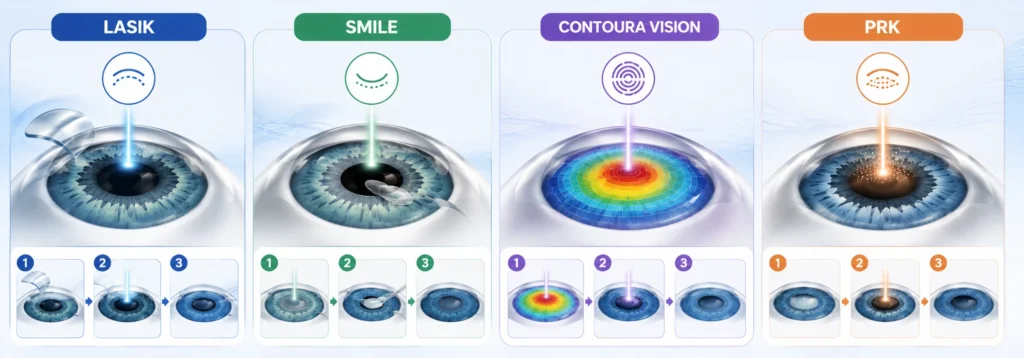
LASIK vs SMILE vs Contoura Vision vs PRK: Which Laser Eye Surgery Is Best? Quick Answer If you’re planning to get rid of glasses or contact lenses, you’ve probably come across LASIK, Contoura Vision, SMILE, and PRK. One of the most common questions patients ask is: “Which laser eye surgery is the best?” The honest answer is that there isn’t one procedure that’s best for everyone. The right choice depends on factors such as: For example: Rather than asking which procedure is “better,” the more important question is: Which procedure is safest and most suitable for my eyes? A comprehensive eye examination is the only way to answer that question confidently. Why This Comparison Matters If you’re considering laser vision correction in Delhi, Gurgaon, Noida, Ghaziabad, Faridabad, or anywhere in Delhi NCR, you’ll quickly notice that different hospitals promote different technologies. Some advertise LASIK, while others highlight Contoura Vision or SMILE as the latest advancement. This can leave patients wondering: The reality is that every procedure has specific indications, advantages, and limitations. The safest option for one person may not be suitable for another. The purpose of this guide is to help you understand the differences between LASIK, Contoura Vision, SMILE, and PRK, so you can have a more informed discussion with your eye surgeon and make a confident treatment decision. Understanding the Difference Between LASIK, Contoura Vision, SMILE and PRK Before comparing these procedures, it’s important to understand that they are not all the same type of surgery. LASIK LASIK (Laser-Assisted In Situ Keratomileusis) is one of the most commonly performed laser vision correction procedures worldwide. A thin corneal flap is created, and an excimer laser reshapes the underlying cornea to correct refractive errors such as myopia, hyperopia, and astigmatism. It has a long track record of safety, rapid visual recovery, and predictable outcomes in suitable candidates. Contoura Vision Contoura Vision is not a separate surgery from LASIK – it is an advanced, topography-guided version of LASIK. Using detailed corneal mapping, Contoura creates a personalised treatment plan based on the unique shape and irregularities of your cornea. For suitable patients, this customised approach may improve visual quality beyond simply correcting spectacle power. SMILE SMILE (Small Incision Lenticule Extraction) is a newer, flap-free laser procedure primarily used to treat myopia and myopic astigmatism. Instead of creating a corneal flap, a femtosecond laser creates a small disc of tissue (called a lenticule) inside the cornea, which is removed through a tiny incision. Because no flap is created, SMILE may be preferred for some patients depending on their eye condition and lifestyle. PRK PRK (Photorefractive Keratectomy) was the first widely adopted laser vision correction procedure and is still an excellent option for selected patients. Unlike LASIK, PRK does not involve creating a flap. Instead, the surface layer of the cornea is gently removed before reshaping the cornea with an excimer laser. Although visual recovery is slower, PRK remains a valuable option for patients with thinner corneas or when flap-based procedures are not recommended. LASIK vs SMILE vs Contoura Vision vs PRK: Side-by-Side Comparison Feature LASIK Contoura Vision SMILE PRK Procedure Type Flap-based laser surgery Topography-guided LASIK Small-incision flap-free procedure Surface laser treatment Best Suited For Common refractive errors Suitable patients seeking customised treatment, especially with astigmatism Myopia and myopic astigmatism Thin corneas or when flap-based surgery is unsuitable Corneal Flap Yes Yes No No Level of Customisation Standard High Moderate Standard Recovery Fast Fast Fast Slower Return to Routine Activities Usually within a few days Usually within a few days Usually within a few days May take longer Suitable for Thin Corneas Usually not Usually not Depends on evaluation Often suitable Dry Eye Impact Moderate Moderate Often lower in suitable patients Temporary during healing Long-Term Results Excellent in suitable patients Excellent in suitable patients Excellent in suitable patients Excellent in suitable patients Expert Insight Many patients assume that the newest procedure is automatically the best. In reality, the most appropriate procedure is the one that matches your eye anatomy and visual needs. Advanced technology is valuable only when it is the right technology for your eyes. Which Procedure Is Right for You? Choosing laser eye surgery isn’t about selecting the most advertised procedure – it’s about selecting the one that offers the best balance of safety, visual quality, and long-term stability. The table below provides general guidance. Your Situation Procedure Often Considered Healthy corneas with common refractive errors LASIK Significant astigmatism and desire for customised treatment Contoura Vision Moderate to high myopia and preference for a flap-free procedure SMILE Thin corneas PRK High-impact sports or occupations where flap-related concerns are relevant PRK Myopia with myopic astigmatism SMILE Desire for highly customised laser correction Contoura Vision Important: This table is intended as general guidance. The final recommendation depends on your eye examination, corneal measurements, and overall eye health. Who Is Eligible for Laser Eye Surgery? Most patients considering laser vision correction share one concern: “Am I eligible?” While eligibility varies between procedures, the following criteria generally apply. You may be a suitable candidate if you: Laser vision correction may not be recommended if you have: Eligibility should always be determined after a detailed eye examination rather than based on age or spectacle number alone. How Eye Surgeons Decide Which Procedure Is Best One of the biggest misconceptions is that patients can simply choose the procedure they prefer. In reality, your eyes choose the procedure. A comprehensive refractive surgery evaluation helps determine which option is safest and most effective by assessing: These findings help your surgeon recommend the procedure that provides the best long-term visual outcome while minimising potential risks. What Tests Are Performed Before Laser Eye Surgery? Before recommending LASIK, Contoura Vision, SMILE, or PRK, your ophthalmologist may perform several diagnostic tests, including: Each test provides valuable information about your eye health and helps determine whether laser vision correction is appropriate and which procedure is likely to provide the best outcome. Laser Eye Surgery in Delhi NCR: Why Personalised Evaluation Matters Patients